Quick answer
If the coroner has removed the person and the property is released, the next step is usually specialist after-death (trauma) cleaning. This is not a normal deep clean. It may involve safe removal of contaminated soft furnishings (like a mattress), controlled decontamination, odour control, and sometimes coordination of repairs if fluids have seeped into flooring.
If you need urgent help, Sparrow Cleaning Limited can advise you on the safest next steps and provide a fast, clear quote. We’re based in Sussex & Surrey, and for specialist jobs we can also travel nationwide where required. For full details of the service, see After Death, Undiscovered Death & Trauma Cleaning.
First: is the property cleared for cleaning?
Before anyone starts cleaning, make sure the property has been released by the relevant authority (for example the coroner/police). If there is any possibility it’s being treated as a crime scene, do not disturb the area and follow official guidance.
What to do immediately (before anyone enters the room)
- Keep people and pets out of the affected room/area.
- Do not move the mattress or bedding (moving items can spread contamination and odour).
- Ventilate if safe (open windows), but avoid spreading air through the whole property.
- Avoid DIY chemicals like bleach “soaking” or heavy perfumes — they can make odour issues worse and don’t solve contamination in materials.
- Take a few photos (only if appropriate) to help with quoting and planning.
Why this isn’t a normal deep clean
After an undiscovered death, contamination may not be limited to “what you can see”. Depending on time, temperature, and materials, fluids can seep into soft furnishings and even into flooring layers. Odour can also absorb into porous surfaces.
That’s why specialist after-death cleaning typically focuses on:
- Safety and controlled decontamination (not just appearance)
- Removal of affected porous items (often including the mattress)
- Odour control using appropriate methods
- Correct waste handling and disposal routes
What happens to the mattress and contaminated items?
In many cases, the mattress and any heavily affected soft furnishings need to be removed and disposed of via the correct route. This is usually the fastest way to reduce odour and prevent ongoing contamination issues.
We’ll advise you clearly on what should be removed, what can be cleaned, and what should be replaced.
Odour control (what actually works)
Odour after an undiscovered death can be persistent because it can absorb into porous materials (mattress, carpet, underlay, wood, plasterboard). Masking sprays rarely solve the problem.
Effective odour control usually involves a combination of:
- Removing affected porous items (often the key step)
- Deep cleaning and disinfection of hard surfaces
- Targeted deodorising methods appropriate to the environment
- Assessing hidden areas (edges of flooring, under bed frames, skirting lines)
Where appropriate, we can also use ozone treatment and/or fogging as part of an odour control plan. These methods are used alongside cleaning and removal work (not as a substitute), and we’ll advise on safe re-entry times and ventilation.
What if fluids have seeped into the floor?
If fluids have seeped into carpet/underlay or into flooring layers, cleaning alone may not be enough. In some cases, sections of flooring, skirting, or plasterboard may need to be removed and replaced to fully resolve contamination and odour.
We can coordinate with trusted partners to arrange repairs (for example replacing floorboards or plasterboard) so the property can be restored properly after the clean.
How the specialist cleaning process works (step-by-step)
- Assessment – we identify affected areas, risks, and what needs removal.
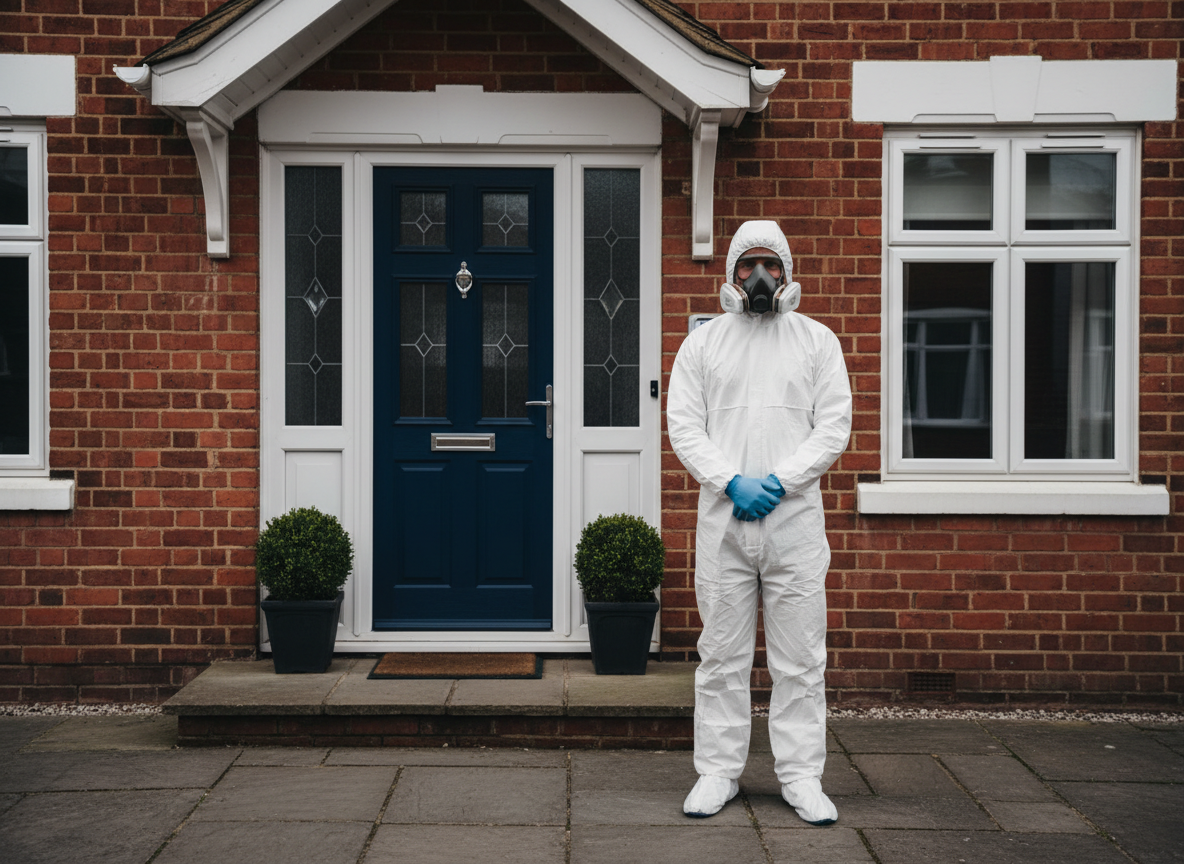
- Controlled setup – PPE and a planned approach to reduce cross-contamination.
- Removal of affected items – mattress/soft furnishings where required, handled safely.
- Cleaning – physical cleaning to remove residues.
- Disinfection – appropriate disinfectants for decontamination.
- Odour control – targeted deodorising where needed (including ozone treatment and/or fogging where appropriate).
- Final check – confirm scope completed and advise on next steps (including repairs if required).
How much does after-death cleaning cost?
After-death and trauma cleaning is usually priced by quote because every situation is different. Cost depends on:
- How long the person was undiscovered (this affects contamination and odour)
- What items are affected (mattress, carpet, soft furnishings)
- Whether fluids have seeped into flooring
- Room count and access
- Waste volume and disposal requirements
- Urgency (same-day / out-of-hours attendance)
For a broader overview of biohazard cleaning and what affects pricing, you can also read: Biohazard cleaning in Sussex (guide).
Service areas
Our core service area is Sussex and Surrey, including Crawley, Horsham, Haywards Heath, East Grinstead, and Redhill.
For specialist after-death and trauma cleaning, we can also travel nationwide depending on the job and availability.
FAQ
Is it safe to go into the room?
If there is strong odour, visible contamination, or you’re unsure, it’s usually best to keep the room closed and get advice before entering. Keep children and pets away.
Do you remove the mattress?
Where required, yes. We’ll advise what needs removing versus what can be cleaned, based on the materials and the level of contamination.
Do you use ozone treatment or fogging for odours?
Where appropriate, yes. We may use ozone treatment and/or fogging as part of an odour control plan, alongside removal, cleaning, and disinfection. We’ll advise on safe re-entry times and ventilation.
Can you help if the smell is still there after cleaning?
Yes — persistent odour usually means contamination remains in porous materials (like carpet/underlay, flooring edges, or soft furnishings). We’ll assess and advise the correct next step, which may include removal and replacement of affected materials.
How long does after-death cleaning take?
It depends on the room size, materials affected (mattress/carpet/flooring), and whether fluids have seeped into porous surfaces. We’ll assess and give a clear plan and timeframe before starting.
Do you cover areas outside Sussex and Surrey?
Yes. Sussex and Surrey are our core service area, but for specialist after-death and trauma cleaning we can also travel nationwide depending on the job and availability.
What if there are needles/sharps in the property?
If there is any sharps risk, do not touch them. Isolate the area and get advice. We also provide biohazard & needlestick cleanup where needed.
Get urgent help
Call our 24/7 response line on 01293 217504 or email our in-hours team at [email protected].
For full details of our specialist service, see: After Death, Undiscovered Death & Trauma Cleaning.